"I want another agent like I want a hole in the head."
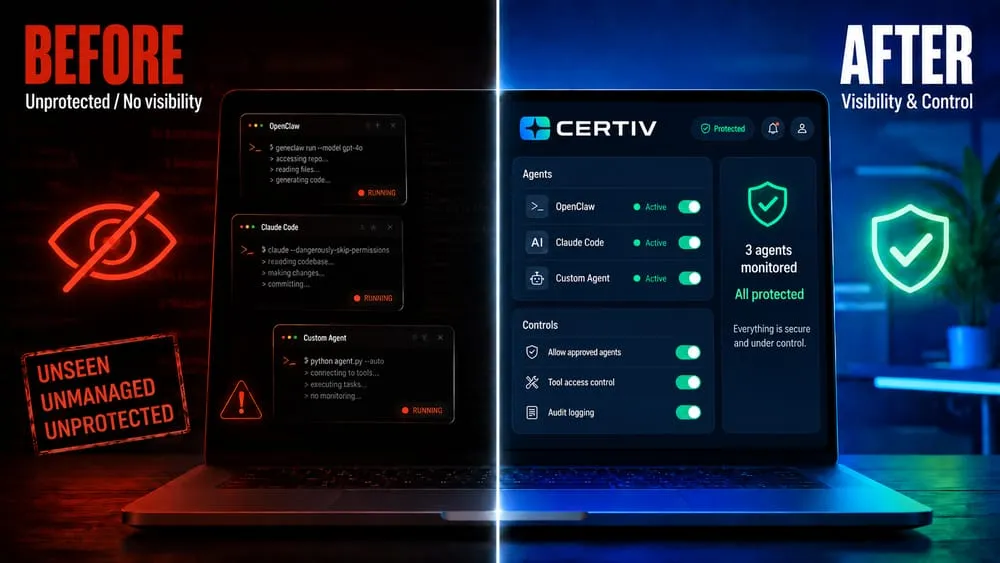
A CISO opened a meeting with us six months ago by saying that. We’ve heard versions of it from nearly every security and IT leader since, and the skepticism makes sense.
If you’re running a modern enterprise endpoint, you’ve already got a stack of these: an EDR like CrowdStrike or SentinelOne, an SSE like Netskope or Zscaler, an MDM like Jamf or Intune, an identity agent, a backup agent, maybe a Tanium client. Each one promised to be lightweight. Each one promised to be the last one you’d need. Then it shows up at the next QBR with a renewal nobody budgeted for and a CPU graph nobody can explain.
And yet, six months in, the same buyers who opened with that line are running Certiv. Not because they got talked into it, but because they looked at their own environment and the conversation changed.
The agent problem isn’t the agent you’re thinking of
The word “agent” is doing two jobs in this conversation.
When a CISO says “I don’t want another agent,” they mean an endpoint agent: software on a laptop, like CrowdStrike or Jamf. Scout, our endpoint agent, is one of those.
When we say AI is reshaping the threat surface, we mean AI agents: Claude Code, Cursor, ChatGPT with computer use, internal copilots wired up to your systems. Models taking actions on a user’s behalf. Your employees are running these right now.
It’s worth being clear about who the actual threat actor is. AI agents will get used by malicious outsiders and insiders, and Certiv helps in both cases. But the bigger problem in the enterprise today, by a wide margin, is the rogue agent deployed by a well-intentioned employee. The engineer who wires Claude Code into a production database to move faster. The analyst who pastes customer data into ChatGPT to summarize a deal. The PM who builds a copilot that touches systems nobody mapped. Nobody is acting in bad faith. They’re trying to do their jobs, and the agents they spin up become the threat surface.
The Three Assumptions AI Agents Break
The endpoint agents you have were built around three assumptions that AI agents quietly break: the actor on the endpoint is a person, the device defines whether the activity is trusted, and “normal” behavior is what you can establish from patterns over time. AI agents break all three at once. The actor isn’t a person, it’s a model. The device is compliant but the workload running on it is autonomous. And “normal” is whatever the model decided to do in the last 400 milliseconds based on a prompt nobody on your team will ever see. AI agents operate inside the trust boundary of a logged-in user on a compliant device, which is exactly where your existing controls stop looking.
This isn’t only a Shadow AI problem. There are plenty of ways to take a swing at Shadow AI: a CASB with AI app categorization, a network proxy doing TLS inspection, a browser extension surveying employees, a quarterly procurement audit. Each of those produces a list. None of them sees the agent’s full action surface: the prompt, the tool call, the data access, and the subsequent action. The endpoint is where the agent’s judgment becomes observable as judgment: the prompt, the tools the agent had access to, the data it pulled into context, the decision it made, and the action that followed, all in one trace on the device where the agent is actually running. A network tap sees encrypted traffic. A CASB sees app usage. A model gateway sees prompts but not what the agent did next. The endpoint is where you can intervene at the moment of judgment instead of after the fact.
Take that vantage point away and you’re doing Shadow AI discovery, which is a smaller problem in a more crowded market.
Certiv is an AI agent assurance platform purpose-built for the AI agent layer. Scout is the endpoint agent that captures judgment-level signal at the device. The Certiv Policy Engine is the control plane that decides what’s allowed, escalates or blocks what isn’t, and gives the CISO and CIO the visibility and control they lack. Scout is what your endpoint team installs. Certiv is what your security and IT organizations buy.
The moment that flips the conversation
Here is an example of the moment that flips the conversation.
An engineer is using a coding agent with an MCP server connected to a production database. They prompt it to “help me debug this customer issue.” The AI agent runs a query, pulls a few thousand customer records into context, summarizes them, and sends the summary to a third-party model API.
What did your stack see? EDR saw a signed binary making an HTTPS call. DLP saw TLS traffic to an approved AI domain. Identity saw a valid SSO session on a compliant device. MDM had nothing to flag. The whole pipeline returned clean, and customer data just left the building.
This isn’t a sophisticated attack. It’s a normal weekday. Existing tools missed it because they were designed to watch a different layer (process behavior, network flow, device posture, user identity). None of those layers can see the prompt, the tool call, the intent, or the data that crossed the boundary.
That’s where buyers come around. They look at their own environment and realize they’ve been flying blind in a place that now matters more than the places they’re already watching. The endpoint is where the agent runs, and it’s the layer that sees the whole loop.
The risk is live in your environment today
The tools you already own weren’t built for this. EDR was built to watch processes. SSE was built to inspect traffic. MDM was built to enforce device posture. None were architected to observe what an AI agent decides between a prompt and a tool call. The gap is structural rather than a feature deficit, and retrofitting a new telemetry surface onto an architecture built for a different problem isn’t going to happen on your timeline.
Your board is already asking which AI tools your organization uses, what data flows through them, and whether you can prove governance. “Our existing vendors are working on it” doesn’t survive contact with that question. Neither does “we’re piloting a CASB add-on.” The problem is live in your environment, and you need control yesterday.
Certiv is built for the real risks of AI agents today: the well-intentioned engineer with an MCP server pointed at your production database this afternoon, on a laptop your existing stack thinks is fine. That’s the problem we’re focused on, and we’re not waiting for the rest of the market to catch up.
Why they say yes
The decision to deploy Certiv is anchored in a dual mandate: satisfying the essential security requirement and minimizing the operational lift.
It controls the security risk. Runtime visibility lives at the layer where the AI agent’s full decision loop is observable, which is the endpoint where it runs. Policy enforcement happens at the moment of judgment rather than after the fact. The questions the board is asking become answerable. The CISO gets a control plane for a surface that didn’t have one. Certiv also answers what the CIO has been asking: which AI tools are people actually using, where is the productivity signal, where are we paying for licenses nobody touches, which teams have figured out workflows that work. Two buyers, same product, different reasons.
Built for simple use and scalable management. Scout is designed for simplicity, deploying in minutes through your existing MDM without the need for kernel extensions, though it does require a single reboot. It operates with a light footprint (maintaining minimal CPU usage and unnoticeable latency), ensuring it never interferes with engineering workflows. By failing open by default, Scout ensures productivity continues uninterrupted. This allows your team to stay focused on their work while Certiv silently manages the risks of rogue agents and autonomous tool calls in the background.
You’ve heard “lightweight” too many times for the word to mean anything on its own, especially with a stack of existing agents that promised the same. The deal closes because the actual operational lift of Scout turns out lower than expected, offering crucial control without the chronic complications of another endpoint tool.
The hole in the head is the missing AI agent assurance layer, a layer no other existing tool is architected to address. Certiv is what fills it, and getting there is lighter than you’d think.
Want to see what’s running in your environment? Learn more about Certiv or schedule a demo.