Endpoint security for AI agents: what your EDR can't see
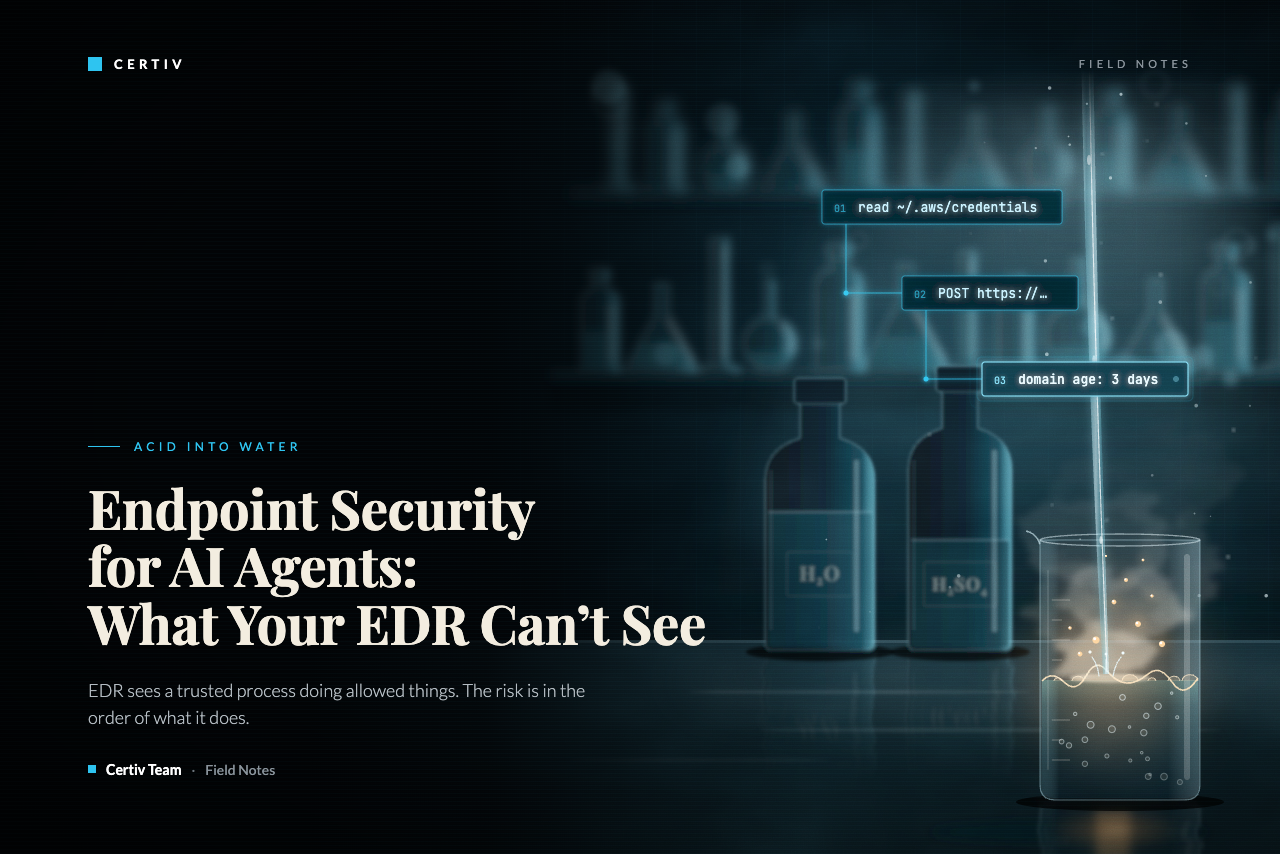
If you remember your high school chemistry, you might remember students learn an important rule before they touch a beaker. Add acid to water, never water to acid. The ingredients are identical either way. Pouring them in one order gets a safe solution, but reverse it, and the mixture can boil and spit acid back at you. The danger isn’t in either bottle, but mix up the sequence and you might need to run for the eyewash station if you get it wrong.
AI agents have the same problem. Every action an agent takes can pass inspection, but an incident can still happen. The risk was never in a single step, rather it was in the order the steps came in.
A developer installs an AI coding agent on a Tuesday afternoon. It’s just another tool, so nobody files a ticket and nothing on its face looks wrong. But by Thursday morning the agent is reading files, running shell commands and calling the network on their behalf. Even an astute IT manager running a solid endpoint tool would see a clean scan. Not for lack of activity. The tool is looking at the wrong thing.
What EDR was built to watch
Endpoint Detection and Response (EDR) watches processes. It asks whether a program is known, whether it behaves like malware, whether it is touching memory it shouldn’t and so on. That approach works for a simple reason: malware, by definition, is software that shouldn’t be there. Find the thing that doesn’t belong, and you’ve found the threat.
But AI agents are a different species. Someone installs one on purpose, it holds all the right accreditation with keys given by its developer and runs as ‘the developer’, allowing it to read files and run commands. Your EDR will certainly see its activity, but only be able to discern that at the surface level it is a trusted process doing ordinary things. Nothing fires. By every rule EDR knows, nothing is wrong.
The sequence is the gap
To make this a little more concrete, say you ask an agent to fix a failing test. Partway through, it runs cat ~/.aws/credentials, the plaintext file where the AWS CLI keeps a long-lived access key and secret for your default profile. A few steps later, it spawns curl and sends an HTTPS POST to a domain registered three days ago. The body is a base64 string, roughly the length of those two keys.
Now, look at each step alone and how they were permitted. The file belongs to the user the agent runs as, and the outbound HTTPS is open. There are many, many developer machines that spawn curl, some hundreds of times a day. But a test fix has no reason to need your cloud credentials, and equally, it also has no reason to talk to a stranger’s server right after reading them. The problem lies within the order of the actions. A tool that judges each event on its own never asks whether that order makes sense for the task. It sees one trusted process, and that process implies that it is behaving normally.
And it doesn’t take a sophisticated attacker to set this off, or any attacker at all. Someone can hide an instruction in a web page or a package’s README and steer the agent on purpose. Just as easily, the model can get it wrong on its own. Either way, the sequence looks the same, and EDR sees the same thing: a trusted process, behaving as instructed.
What it takes to close the gap
You need something on the endpoint that sees each action an agent takes and decides what to do with it before it runs. We call it endpoint security for AI agents. It doesn’t replace EDR, but it does sit alongside it as a separate layer. Our solution for this layer is called Scout.
So here’s the question worth asking: when an agent is about to act, what can your tools actually do about it? Can they:
- Allow the action and keep a record
- Pause it until a person approves
- Stop it outright
- Block it and tell the agent why, so it can find a safer route
Of everything on that list, being able to tell the agent why it was stopped is the capability people tend to underestimate. Agents are good at working around a flat refusal, and they respond well to a clear reason. In our earlier example, Scout would have blocked the credentials read and explained to the agent that a test fix doesn’t need cloud keys. The agent would have moved on and fixed the test.
Most teams start with coding agents, since that’s where agents already have the most autonomy and the most access. For a closer look at how Scout makes its decision before an action runs, see pre-execution policy enforcement.
Where this leaves your EDR
Does this mean you should throw away your EDR? No, of course not. EDR still does the job it was built for. But agentic activity needs a different kind of visibility, one tied to intent with control to hold back that action before anything executes. Scout covers the gap by adding a second view of the same laptop which reads actions in sequence rather than processing actions one at a time.
The same goes for Microsoft’s tooling. Defender for Endpoint can now discover agents on Windows and macOS endpoints and score how risky each one looks, and it feeds that inventory to Agent 365 and Intune. Scout complements that by deciding, action by action, what a running agent is allowed to do before it does it. Together, they answer two different questions: which agents are on your machines, and what each one is allowed to do right now. To see how Scout handles the enforcement side, take a look at the platform. Even in a high school chemistry lab, the rule is taught once and trusted forever. With agents, it has to be enforced on every pour.
If you would like to see this on a real laptop, book a demo with us!
Frequently asked questions
What is endpoint security for AI agents?
It means deciding on an agent’s actions on a laptop before they run, based on whether they fit what the user asked for. It works alongside EDR.
Can EDR see AI agent activity?
Partly. It sees the process and the file and network activity around it. A trusted agent doing allowed things looks normal to it.
How do you get AI agent visibility on endpoints?
You need something on the endpoint that sees each agent action, not just the process. Scout does that and records every action it decides on.
Does this replace EDR?
No. EDR covers the process layer and Scout covers the action layer. You keep both. They are watching for different things.