The Art of (Agent) War
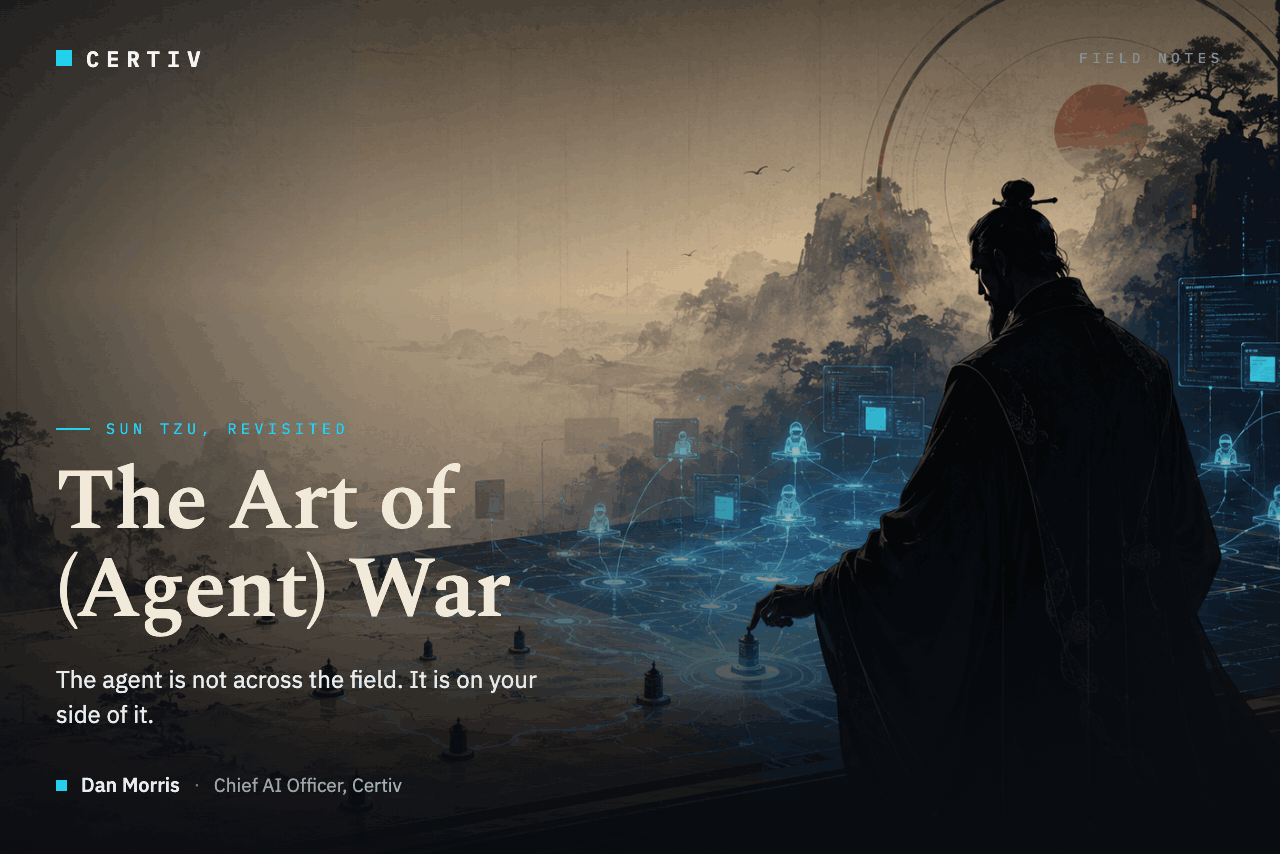
Around the fifth century BCE, a Chinese general named Sun Tzu began writing about conflict - not about swords or armies, but about the conditions that determine victory and defeat.
His observations were so fundamental that The Art of War is still studied by military leaders, politicians, founders, and executives more than two thousand years later. Because while the weapons of war change, the nature of conflict rarely does.
Every generation eventually finds itself on a new battlefield. A new technology emerges. Old assumptions fail. The speed of conflict accelerates and the old maps become useless.
Those who mistake a new battlefield for an old one often lose before they realize the war has begun. Our generation’s battlefield happens to be inhabited by machines.
Machines that reason, plan, and act on our behalf. They pursue objectives, use tools, make decisions, and increasingly interact with one another with minimal human involvement. They are becoming participants. Actors. Agents.
And like every commander facing a new kind of combatant, our instinct is to reach for the oldest manual we have.
If you know the enemy and know yourself, you need not fear the result of a hundred battles.
It is a good instinct. But it conceals a mistake. One hidden in the very first word.
The Enemy Was Never the Enemy
Sun Tzu assumes an adversary. Someone on the far side of the field, whose defeat is the point. The entire art is organized around an opponent, yet look closely at the agent.
It is acting on your behalf. Pursuing your objectives. Carrying your credentials. It runs inside your perimeter, reads your data, and touches your systems - not because it breached them, but because you invited it in.
The agent is not across the field. It is on your side of it.
Which means the hard half of Sun Tzu’s line was never “know the enemy.” It was “know yourself.” The agent is not an adversary to be defeated. It is a force under your command, closer to a lieutenant than an enemy. And the problem a commander faces with his own forces is not destruction.
It is command.
This is the quiet category error running through most of how we think about agent security today. We keep reaching for the language of war - threats, attacks, defense, denial - because it is the doctrine we inherited. But you do not defeat your own army. You direct it. And an army whose movements are invisible cannot be directed. A lieutenant whose intentions are unknowable cannot be trusted. A force whose actions you cannot see is as much a danger to your own side as to anyone else.
Understanding, not victory, is the first task. Everything else depends on it.
New Weapons for a New Battlefield
Every generation arrives on a new battlefield carrying the weapons of the previous one - and it is almost always a mistake.
We are making it again.
Watch what happens when a security team is handed responsibility for agents. They reach for the tools on the shelf - the EDR platform, the DLP suite, the SIEM. They bolt agent oversight onto CrowdStrike, onto Zscaler, onto whatever was built to defend the network from the outside. These are excellent weapons. They were designed to repel an adversary at the perimeter, at human speed, after the fact.
But the agent is not at the perimeter. It is already inside, holding your keys. The threat model those tools were built for does not describe the situation at all. Pointing them at agents is fighting the new war with the instruments of the last - and worse, with instruments built for an enemy that, in this case, doesn’t exist.
The deeper mismatch is speed. An agent can think, reason, and act in moments. It can take more actions in a minute than a human could meaningfully inspect in an hour. Dashboards, tickets, and after-the-fact investigations are human-speed processes attempting to govern a machine-speed actor. By the time a human reads the alert, the agent has moved on.
To command a machine, we increasingly need another machine.
But if we are to build these new instruments of command - what should they actually do?
The Supreme Art
Our first instinct is to block, deny, and terminate. To treat every uncertain action as a threat to be stopped.
History suggests otherwise. The greatest commanders did not seek victory through endless battles. Every engagement carries a cost. Every conflict introduces uncertainty. Even victory consumes resources. So they sought something more elegant.
The supreme art of war is to subdue the enemy without fighting.
The same lesson applies, sharpened by the fact that the agent is your own force. You do not want to subdue it. You want it to succeed at the right thing, within the right limits.
So the objective is not to destroy the agent. It is to shape its behavior. To guide its decisions. To expand its options when the stakes are low and constrain them when the stakes are high. To ask for confirmation before the irreversible step. To steer it, quietly, toward the outcome you wanted all along.
The best instruments of command are not instruments of destruction. They are instruments of guidance. The goal is to reach the right outcome without the battle ever taking place.
Like a Thunderbolt
Of course, not every battle can be avoided. Sometimes an action must be denied. Sometimes an agent must be stopped. Sometimes a human must be pulled into the fray.
But command delayed is command denied.
Let your plans be dark and impenetrable as night, and when you move, fall like a thunderbolt.
The power of the thunderbolt is not merely its speed. It is its decisiveness. For most of a campaign, a commander observes. He gathers intelligence, studies the ground, and waits. And then, when the moment comes, he acts without hesitation.
Picture the moment that matters. An agent has the commit staged, the message drafted, the customer records assembled and addressed to somewhere they should never go. The decision to allow or stop it has a shelf life measured in milliseconds.
An intervention that arrives after the code is committed, after the message is sent, after the data has left the machine is not command.
It is history.
To command machine-speed actors, we must be capable of machine-speed decisions. Observe patiently. Understand deeply. And when action becomes necessary, move like a thunderbolt.
Command
The Art of War has endured for more than two thousand years because it was never really about armies. It was about command.
The irony is that its oldest assumption - that there is an enemy across the field - is the first thing this new battlefield asks us to set down. The agents are not the adversary. They are the force we have to learn to direct: faster than us, tireless, acting in our name, and entirely dependent on us to know where the line is.
The battlefield has changed. The combatants have changed. The challenge has not.
How do we retain command in a world increasingly populated by autonomous actors acting on our behalf?
That question is the one we built Certiv to answer. Book a conversation and we’ll show you what command looks like on a real endpoint, at the speed the agents are already moving.
- Daniel, Chief AI Officer, Certiv